By Ryan Long, Marguerite Nairac, Suzanne Slovak, and William Lawrence
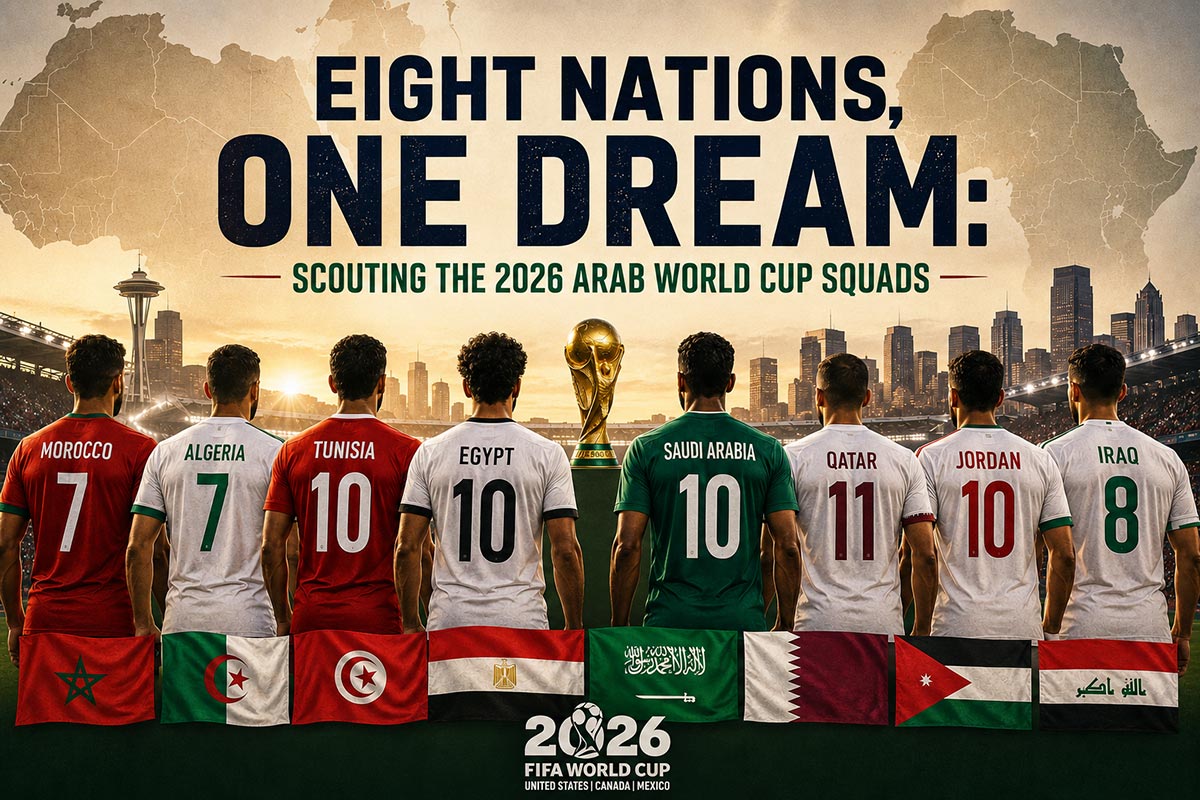
For generations, Arab fans watched the World Cup with enthusiasm but divided loyalties, often adopting European or South American teams as secondary choices. In 2026, the narrative has shifted, and the Middle East and North Africa are no longer mostly spectators. For the first time, with the tournament expanding from 32 to 48 teams, an unprecedented eight Arab nations—Morocco, Algeria, Tunisia, Egypt, Qatar, Iraq, Saudi Arabia, and Jordan—have qualified for the FIFA World Cup launched late this week in Mexico, Canada, and the U.S. From Morocco’s elite heavyweight status to Jordan’s fairytale debut, this is a golden era for Arab football.
As the 2026 World Cup begins, teams from Arab and Muslim nations are building upon the momentum generated four years ago following the first World Cup in an Arab country, Qatar. Muslim-majority and -plurality nations now number 14, with the qualification of the eight Arab countries plus Senegal, Côte d’Ivoire, Bosnia and Herzogovina, Turkey, Iran, and Uzbekistan. But the strongest regional story is North Africa’s remarkable presence at the tournament. Every North African state but Libya has qualified. They are joined by two Arab Gulf states—Saudi Arabia and Qatar—as well as Gulf neighbor Iraq and nearby Jordan.
The prominence of MENA nations at the 2026 World Cup represents broader transformations in international football. The achievements of regional teams, coupled with Qatar’s hosting of the 2022 tournament, have given the region a new place in the sport. As Morocco prepares to co-host the 2030 World Cup and Saudi Arabia looks ahead to 2034, the Middle East and North Africa appear poised to play a more influential role in football’s global landscape.
The 2022 FIFA World Cup marked a landmark moment in this story. Qatar became the first MENA country to host the tournament in its 96-year history, drawing worldwide attention to Arab football, culture, and identity. The competition also produced some of the most memorable achievements in the region’s football history. In the group stage, Saudi Arabia stunned the world with its 2-1 victory over the eventual champions, Argentina, while Tunisia defeated the defending champions, France. Along the way, Morocco defeated European powerhouses Belgium, Spain, and Portugal, becoming the first Arab or African nation to reach the semi-final. These successes resonate far beyond the game itself. Celebrations erupted across North Africa, the Middle East, and diasporic communities worldwide, including memorable cheering by many thousands of Algerians along the sometimes-contentious border with Morocco. As Morocco advanced through the tournament, millions across the region embraced the team as their own, transforming its historic run into a shared source of Arab and African pride.
Our Scouting Report:
Morocco: Now ranked seventh in the world, the Atlas Lions are only the second MENA team to break the FIFA top ten, after Egypt peaked at 9th in 2010. The team touched down in Basking Ridge, New Jersey, where they spent their time training and practicing between matches, including a drawn friendly with Norway last week. Morocco has been labeled a wild card contender to win the tournament after their shocking World Cup success in 2022 and other accomplishments. The team’s star player and captain, Achraf Hakimi, recently won the UEFA Champions League final with his teammates from Paris Saint-Germain, beating out Arsenal 4-3 in an epic final. While the team has been riding on its victories and strengths, they have not escaped controversy in recent years. In the 2025 AFCON final, at first Morocco apparently had lost to Senegal. However, in March, the Confederation of African Football overturned Senegal’s on-field victory and awarded Morocco a 3-0 win, ruling that Senegal violated tournament regulations by leaving the pitch in protest during the match. This overturning of the Senegalese victory was met with global backlash, with some claiming the win as a disgrace, causing the Atlas Lions to lose some of their luster. Also leading the news this month has been the significant number of Moroccan fans whose visas to attend the World Cup were revoked or denied. But the Moroccan team and loyal supporters remain undaunted. The large and enthusiastic Moroccan diaspora in the U.S. will be out in force and expect to cheer the team’s advancement far into the tournament.
Algeria: The second-ranked Arab League member team is Les Fennecs, which refers to desert foxes. Algeria’s attendance at the 2026 games is its first appearance in the group stage in more than 10 years. Like Morocco, les Fennecs have not been spared from a controversy not of their own making. At the 1982 World Cup, Algeria became the first African team to eliminate a European team in the group stage. They defeated West Germany 2-1; however, West Germany and Austria colluded during their game the next day. West Germany and Austria deliberately manufactured a 1-0 victory for the Germans, and the narrow scoreline sent both European teams to the next stage, eliminating Algeria. This series of events later became known as the Disgrace of Gijón and led FIFA to alter World Cup rules, requiring all final group-stage games to be played at the same time on the same day to prevent teams from colluding. Algeria’s gameplay has historically sent waves through the World Cup, and most experts expect them to perform better than their world ranking of 28th and advance from group play, especially if they can beat or tie Austria in their third match.
Egypt: Just one behind Algeria in international rankings, the Pharaohs are set to kick off their World Cup campaign in Seattle, Washington, against Belgium, with the participation of globally revered star Mohamed Salah. On the continental stage, Egypt is one of the most decorated countries, with a record seven Africa Cup of Nations titles. However, this continental success has not been fully replicated on football’s biggest stage. Egypt’s World Cup appearances have been relatively infrequent, and the Pharaohs have not advanced beyond the first round since their tournament debut in 1934. Their aspirations in 2026 remain closely tied to the leadership and brilliance of Salah, widely regarded as one of the world’s most influential players. At club level, Salah starred for Liverpool FC, where he built a global reputation as a prolific goal scorer, before recently announcing his retirement. Off the pitch, Salah has also drawn attention for his public commentary on humanitarian issues related to Gaza. Following widely reported incidents involving Palestinian footballers and civilians, including reactions to tributes posted on X, his statements have sparked significant online discussion and debate.
Tunisia: Tunisia is no stranger to the world cup. The 2026 tournament marks their third consecutive appearance in the tournament and seventh overall, second only to Cameroon in Africa for total appearances. Ranked 45th globally, the Carthage Eagles enjoyed an impressive qualifying campaign, reaching the tournament without conceding a single goal. They have been drawn into a difficult group, alongside Japan, the Netherlands, and Sweden. However, Tunisia has proven they can compete with football’s elite. At the 2022 World Cup, they stunned the defending champions, France, with a remarkable 1-0 victory, proving that they are not a team to be underestimated. Head coach Sabri Lamouchi has been realistic about his side’s ambitions, asserting that Tunisia is not among the favorites to win the tournament. Nevertheless, he has emphasized the importance of leaving everything on the pitch and making the Tunisian people proud. As Lamouchi put it, he wants his players “to feel they left nothing inside themselves, that they gave everything, enjoyed the experience and gave the Tunisian people great emotions.”
Qatar: Before hosting the 2022 FIFA World Cup, Qatar had never qualified. Following their successful campaign in the AFC Asian Qualifiers, the Maroons (referring to the national purplish color) have secured a place at the 2026 tournament and will compete in Group B alongside Canada, Bosnia and Herzegovina, and Switzerland. Managed by Spanish coach Julen Lopetegui, the squad relies heavily on domestic talent—nearly the entire roster plays in the Qatari Stars League. Their attack is spearheaded by the creative Akram Afif and all-time record goalscorer Almoez Ali. They have found some continental success, including winning the AFC Asian Cup. To win at the World Cup they will have to rely on their improved defensive tactical discipline and counterattack. Advancing past group stage for a team ranked 56th globally would be monumental.
Iraq: Iraq’s return to the 2026 World Cup is one of the tournament’s most compelling stories. Ranked one below Qatar by FIFA, the Lions of Mesopotamia last qualified for the World Cup at the 1986 tournament in Mexico, making their return a major achievement for Iraqi football. The team enters the competition under the guidance of new Australian coach Graham Arnold, who previously led Australia at the 2022 World Cup in Qatar. Iraq’s footballing history has been shaped by significant challenges both on and off the pitch. Decades of political instability and economic hardship hindered the sport’s development, while the national team also faced serious internal difficulties. Following his appointment as president of the Iraq Football Association (IFA) in 1984, Saddam Hussein’s son Uday became notorious for the abuse of athletes, with numerous players alleging that those who failed to meet his expectations were imprisoned and tortured. His influence over Iraqi sport lasted for nearly two decades. More recently, the team has continued to face obstacles. In the lead-up to the tournament, striker Aymen Hussein, whose goal sealed qualification, was detained for questioning for seven hours upon arriving at Chicago’s O’Hare Airport before being granted entry, while the team’s photographer was refused admission altogether, creating an unexpected controversy ahead of Iraq’s first World Cup appearance in forty years. A last-minute qualifier, Iraq faces a formidable task, having landed in one of competition’s two toughest groups, alongside France, Senegal, and Norway.
Saudi Arabia: Saudi Arabia has qualified for the 2026 World Cup under brand new leadership. Former head coach, Herve Renard, was dismissed in April, less than two months before the tournament begins. In 2022, Renard famously guided the Green Falcons to one of the biggest upsets of the tournament, as they defeated the eventual tournament winners, Argentina, 2-1 in the Group Stage. Renard has been replaced by Georgios Donis the former Greek international and experience manager. Donis is well acquainted with Saudi football, having previously coached several Saudi club teams including, Al Hilal, Al Fetah, and Al Wehda. Saudi Arabia, ranked 60th in the world, will hope that this familiarity coupled with his extensive knowledge of the game will have an impact on their performance in in Group H, where they will face Cape Verde, Spain, and Uruguay. Much has taken place since Saudi Arabia defeated Morocco 2-1 in the group stage of the 1994 World Cup at Giant Stadium in New York.
Jordan: Jordan’s qualification for the 2026 World Cup marks an historic achievement, as it is the nation’s first appearance at football’s biggest tournament. This accomplishment has generated considerable excitement across the country, with many Jordanians hoping Al-Nashama—or “The Brave Ones”—can emulate Morocco’s remarkable 2022 run. Despite the enthusiasm, some supporters remain cautious about Jordan’s prospects. Critics argue that the country’s qualification was aided by FIFA’s expansion of the tournament from 32 to 48 teams and question whether the 63rd ranked team in the world globally has the quality necessary to progress beyond the group stage. Nevertheless, anticipation continues to build as the tournament approaches. Jordanian flags are appearing everywhere in cafés and shisha bars, and fans are eagerly counting down to the 16th of June, when Jordan will make its World Cup debut against Austria in San Francisco. Jordan will also likely have to engage in friendly fratricide and knock off their Algerian brothers.
Egypt will face off against Iran in Seattle. While a Gulf country but not Arab, Iran’s qualification for the 2026 FIFA World Cup has become one of the tournament’s most significant examples of how sport and diplomacy intersect amid geopolitical tensions. After securing its place at the World Cup, uncertainty initially surrounded whether Team Melli—ranked 20th in the world ahead of seven of the eight qualifying Arab teams—would even participate. Iran has even attacked four of the Arab World Cup qualifying teams in recent months. Amid these escalating tensions, Iranian officials suggested in during the winter that the country’s participation in the tournament was not guaranteed. The situation evolved in March when U.S. President Donald Trump publicly reaffirmed that Iran would be welcome to compete in the United States, one of the tournament’s three host nations. FIFA President Gianni Infantino embraced the moment as evidence of football’s unique diplomatic role, writing that “Football Unites the World” and thanking the United States for its support of the tournament’s inclusive mission. By late April, Iranian officials formally confirmed the team’s participation, signaling that the World Cup would proceed as a rare arena where political rivals could engage through sport rather than confrontation.
The episode highlights FIFA’s efforts to assert its position as a global sporting institution capable of bringing together nations that otherwise have limited avenues for engagement. Yet the challenges facing Iran at the tournament have not disappeared. Current plans require the Iranian team to establish its base camp in Tijuana, Mexico, rather than remain overnight in the United States. As a result, Team Melli is expected to travel back and forth across the border for matches hosted in American cities, creating a unique logistical burden not faced by most competing nations. These complications underscore the broader political realities that continue to shape the tournament even as FIFA promotes a message of international unity. Against this backdrop, Iran’s group-stage matchup against Egypt in Seattle carries significance beyond the sporting contest itself, serving as a high-profile example of national pride, international visibility, and the continuing role of the World Cup as a platform for diplomacy and people-to-people connection.
The 2026 World Cup has reignited debates about the relationship between international sport, cultural values, and human rights. One of the most notable examples centers on the Egypt–Iran match in Seattle on June 26, as reports emerged that both countries had requested a scheduling adjustment away from Pride Night that FIFA ultimately declined to grant. The controversy has prompted broader discussions about the extent to which international sporting organizations should accommodate the cultural, political, and social sensitivities of participating nations. FIFA has maintained that tournament schedules and organizational decisions must be applied consistently across all teams and host venues, while respecting the framework established by the host country. Supporters of this approach view it as necessary for preserving neutrality and ensuring the smooth operation of global competitions. Critics, however, argue that major sporting events cannot be separated from wider questions of human rights and cultural representation. As a result, the dispute has become part of a larger conversation about how international sport should balance universal principles with the diverse values and traditions represented by participating nations and host societies.
The 2026 FIFA World Cup represents a landmark year for North Africa and the Middle East (increasingly referred to as NAME in English in North Africa). Never before have so many nations from the region been represented on football’s biggest stage, representing the region’s growing investment in the sport and the progress of their national teams. Each country arrives in North America carrying their nation’s culture, hopes, and expectations with them. Regardless of how far they go, simply being at the tournament highlights the ever-increasing influence of Africa and Asia in international football. While the story begins to unfold in North America, fans from Rabat to Riyadh, from Dar El Beida to Doha, and from Algiers to Amman—via Tunis, Cairo, and Baghdad—will be watching closely, united by this exciting new chapter in the history of North African and Middle Eastern football.
National Council on U.S.-Arab Relations colleagues Michael Busch in Jordan and Fatim Zahra Oukaballa in Morocco were interviewed for this article.