The Levant and Middle East Area Studies Program is an interdisciplinary initiative dedicated to advancing understanding of U.S. policy toward the Levant and the broader Middle East, including Iraq and the Gulf. Aligned with the mission of the National Council on U.S.-Arab Relations, the program serves as a rigorous platform for analyzing the evolution, diplomatic tools, and strategic implications of American engagement in one of the world’s most consequential regions.
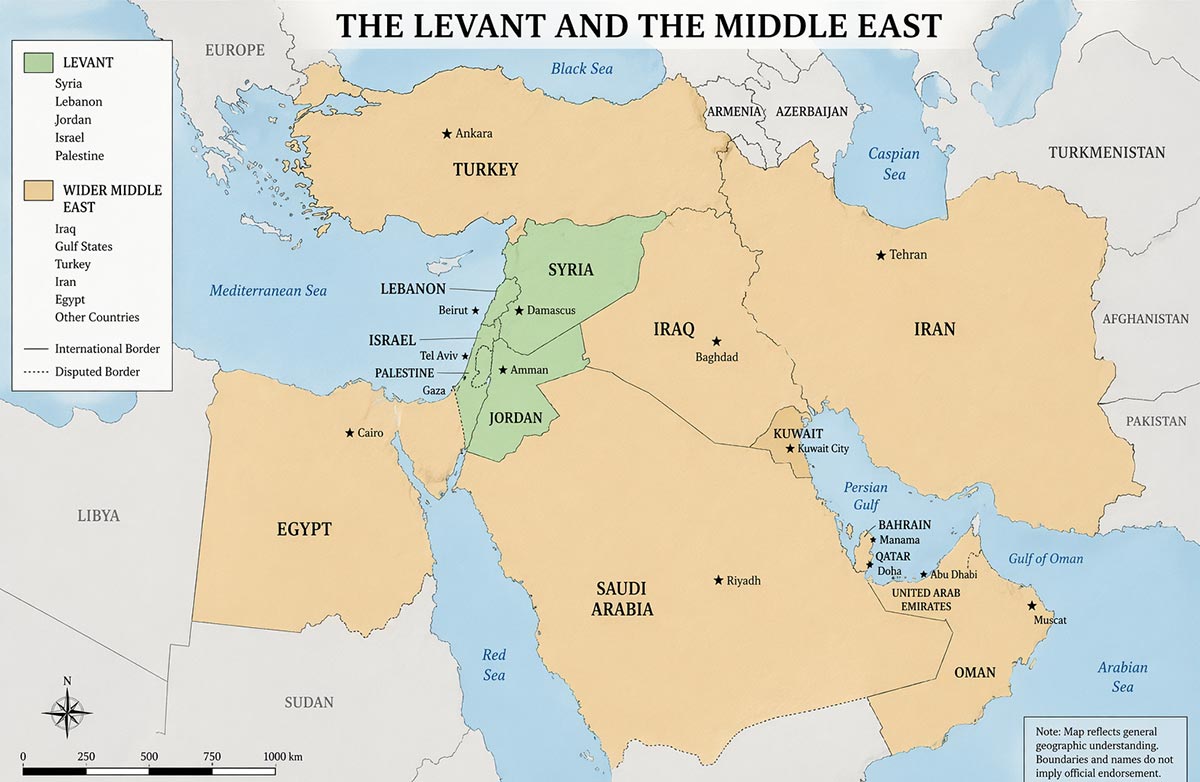
At its core, the program prioritizes the study of U.S. foreign policy—its diplomatic architecture, security commitments, and economic partnerships—across the Levant, Iraq, and the Gulf states. It examines American contemporary policy challenges and strategic decision-making, while also assessing the domestic political, institutional, and international constraints that shape policy outcomes.
The program situates U.S. engagement within the region’s enduring geopolitical significance. The Middle East remains central to global energy security, maritime trade routes, and military posture, while emerging dynamics—such as great-power competition, technological shifts, and evolving regional alignments—continue to redefine its strategic landscape. Particular attention is given to the Levant as a nexus of security dilemmas and diplomatic contestation, as well as to the Gulf’s pivotal role in energy markets and economic transformation.
A defining feature of the program is its analytical focus on policy formulation and execution. Case-based analysis of recent and ongoing developments provides insight into the practical challenges of navigating competing priorities, from countering regional adversaries to managing alliances and fostering stability.
Through lectures, high-level seminars, briefing events, and policy papers the program convenes scholars, practitioners, and policymakers to cultivate informed, policy-relevant discourse. By combining strategic analysis to historical exposition, the Levant and Middle East Area Studies Program emphasizes the conceptual frameworks and practical insights necessary to assess and shape U.S. policy in a rapidly evolving regional and global context.
This program is directed by Dr. Fadi Hilani, Senior Academic and Research Fellow-in-Residence at the National Council on U.S.-Arab Relations.
Dr. Hilani is a scholar of U.S. Middle East policy and international relations, with academic training in both the United States and the United Kingdom. He holds a Ph.D. in Linguistics from the University of Essex and a Master’s degree in Near Eastern Studies from New York University. His academic career included appointments at Aleppo University in Syria, Isra University in Jordan, Montclair State University, and the City University of New York in the United States.
His research and policy work center on U.S. engagement in the Middle East, regional security dynamics, and the intersection of diplomacy with emerging global trends. In parallel with his academic work, Dr. Hilani is a frequent contributor to international media, where he provides analysis on regional conflicts and American foreign policy. Through his scholarship and public engagement, he contributes to fostering informed dialogue and advancing a deeper understanding of U.S.-Arab relations.