Click Here to Watch LIVE on YouTube
Thursday, June 11, 2026
9:00 a.m. – 10:00 a.m. / Eastern Time
Registration is NOT REQUIRED to view the program.
Submit questions to the specialists: questions@ncusar.org
Background and Context
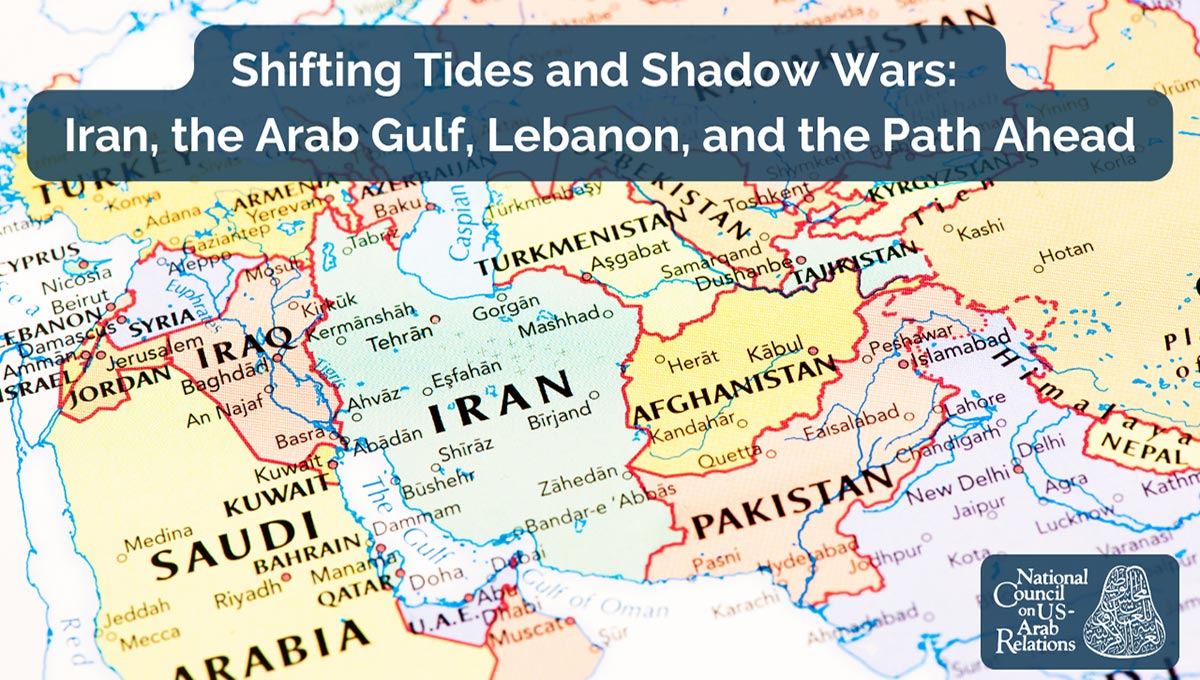
The National Council on U.S.-Arab Relations is pleased to convene a distinguished panel of a senior diplomat and leading regional experts to examine the cascading consequences of the Iran conflict, the fragile situation in Lebanon, and the strategic recalibrations underway across the Arab Gulf states.
The discussion will feature Ambassador Massoud Maalouf, a veteran Lebanese diplomat and Dr. Abdullah Baabood and Dr. Kristian Coates Ulrichsen, renowned scholars of Gulf affairs. As the Iran war surpasses its hundredth day, Iran has re-suspended its military response to Israel for attacks in Lebanon and warned it would resume full-scale attacks if triggered by Israeli attacks. A senior Iranian official has told international media that Tehran sees no serious will from Washington to finalize a deal. Meanwhile, the Iran-backed Houthi rebels have announced a new ban on Israeli shipping in the Red Sea.
For the Gulf Arab states, the war has forced uncomfortable choices. Iran directed roughly 83 percent of its total missile and drone strikes at GCC countries. Saudi Arabia has been forced to reroute oil exports through a Red Sea port, now threatened by the Houthi declaration. Oman maintains its neutral position and open diplomatic channels even as other Gulf states hardened their postures. Israel has seized around a fifth of Lebanon in a ground invasion, and strikes on southern Lebanon continue daily including attacks on Beirut in defiance of President Trump. Hezbollah has rejected the U.S.-brokered deal, insisting that any ceasefire in Lebanon must be part of a comprehensive deal. Drawing on the panelists’ combined expertise, this webinar will assess what is happening and what comes next: whether pauses in hostilities can be transformed into lasting peace, what role Gulf states and Lebanon will play in shaping outcomes, and what a post-conflict regional order might look like for U.S.-Arab relations, security, and economic recovery.
Welcoming and Introduction:
- Dr. William Lawrence, Senior Academic and Research Fellow-in-Residence, Director of the North Africa Area Studies Program, National Council on U.S.-Arab Relations | Bio
Moderator:
- Dr. Abderrahim Foukara, Distinguished Fellow for U.S.-Arab Affairs and Media Leadership, National Council on U.S.-Arab Relations; Former Washington D.C. Bureau Chief, Al Jazeera | Bio
Speakers:
- Dr. Abdullah Baabood, Chair of the State of Qatar for Islamic Area Studies; Visiting Professor at the Faculty of International Research and Education, Waseda University, Tokyo-Japan | Bio
- Ambassador Massoud Maalouf, Former Ambassador of Lebanon to Canada, Poland, and Chile | Bio
- Dr. Kristian Coates Ulrichsen, Fellow for the Middle East, Rice University’s Baker Institute for Public Policy; Co-Director, Middle East Energy Roundtable | Bio