Click Here to Watch LIVE on YouTube
Thursday, June 18, 2026
11:00 a.m. – 12:30 p.m. / Eastern Time
Registration is NOT REQUIRED to view the program.
Submit questions to the specialists: questions@ncusar.org
Background and Context
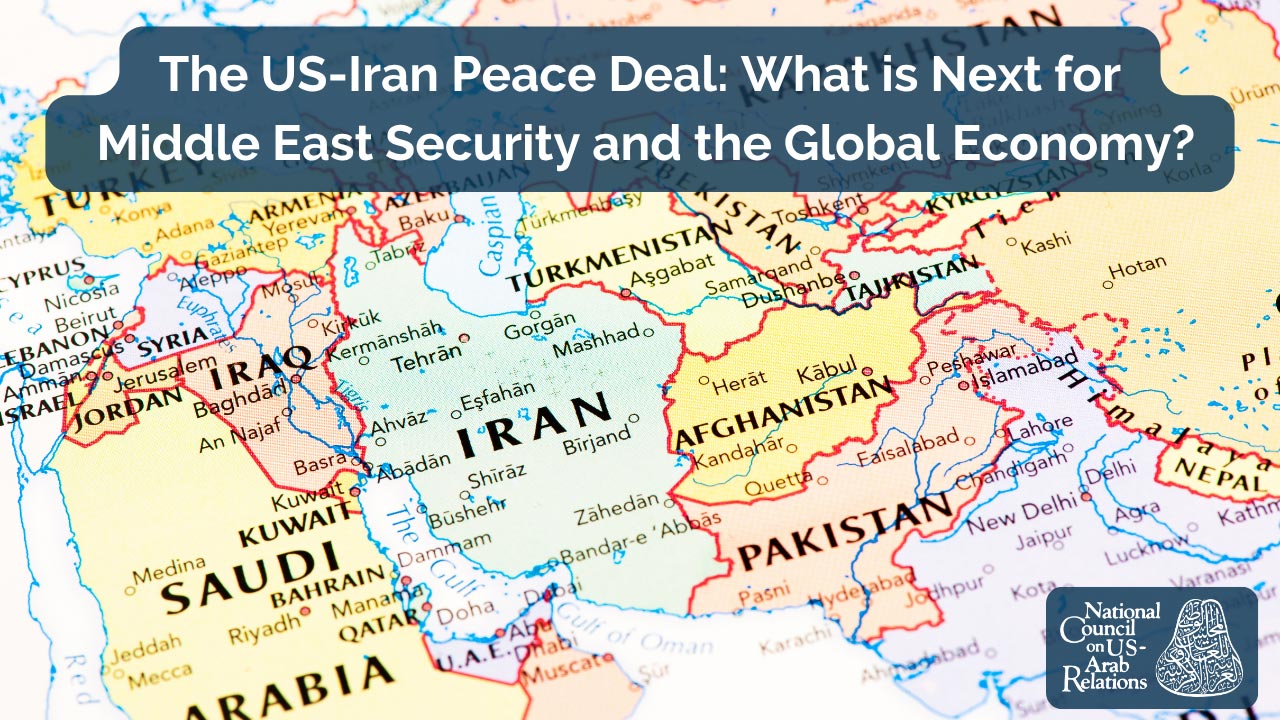
The National Council on U.S.-Arab Relations is pleased to convene this timely webinar to examine the implications of the Memorandum of Understanding between the United States and Iran. As this landmark agreement begins to reshape regional calculations, the Council brings together leading voices to assess what this diplomatic turning point may mean for the Gulf, the Middle East, and the broader international system.
The panel will feature Ambassador James Jeffrey, former U.S. Special Representative for Syria and Special Envoy to the Global Coalition to Defeat ISIS; Mr. Phillip Cornell, Senior Energy Advisor with The Economist and a Senior Fellow at The Atlantic Council; Dr. Sara Vakhshouri, energy and geopolitical risk expert and President of SVB Energy International; and Dr. Kristian Coates Ulrichsen, Fellow for the Middle East at Rice University’s Baker Institute and a leading scholar on Gulf politics and international relations. Together, they bring deep diplomatic experience, economic expertise, and academic insight into the evolving strategic environment.
This discussion will move beyond the symbolism of the agreement to examine its operational and strategic consequences in detail. While the MOU signals a potential de-escalation in U.S.–Iran tensions, it leaves unresolved core questions about verification mechanisms, the scope and limits of Iran’s nuclear activities, and the sequencing of sanctions relief. It also raises urgent issues regarding maritime security in the Strait of Hormuz, the future of Iran’s regional network of influence, and the responses of Gulf Arab states as they recalibrate their own security and economic strategies. Does this agreement mark the beginning of a managed regional equilibrium, or does it simply freeze underlying rivalries in place? How will competing interpretations of compliance shape the next phase of diplomacy? And to what extent can economic incentives and security guarantees be aligned to sustain the deal beyond its initial implementation window? The webinar will explore whether this MOU can evolve into a durable framework for regional stability—or whether it will become another short-lived pause in a cycle of escalation and renegotiation.
Welcoming and Introduction:
- Dr. Fadi Hilani, Director of the Levant and Middle East Area Studies Program, Senior Academic and Research Fellow-in-Residence, National Council on U.S.-Arab Relations | Bio
Moderator:
- Dr. Abderrahim Foukara, Distinguished Fellow for U.S.-Arab Affairs and Media Leadership, National Council on U.S.-Arab Relations; Former Washington D.C. Bureau Chief, Al Jazeera | Bio
Speakers:
- Amb. (Ret.) James Jeffery, Former Ambassador to Iraq, Albania, and Turkey; Former U.S. Special Envoy to the Global Coalition To Defeat ISIS and to Syria; Philip Solondz Distinguished Fellow, The Washington Institute | Bio | Recent Article
- Mr. Phillip Cornell, Senior Energy Advisor, The Economist; Senior Fellow, The Atlantic Council | Bio
- Dr. Sara Vakhshouri, Center for Energy Security and Diplomacy Chair, Institute for World Politics; Founder and President, SVB Energy International | Bio
- Dr. Kristian Coates Ulrichsen, Fellow for the Middle East, Rice University’s Baker Institute for Public Policy; Co-Director, Middle East Energy Roundtable | Bio