Click Here to Watch LIVE on YouTube
Thursday, April 28, 2026
10:00 a.m. – 11:30 a.m. / Eastern Time
Registration is NOT REQUIRED to view the program.
Submit questions to the specialists: questions@ncusar.org
Background and Context
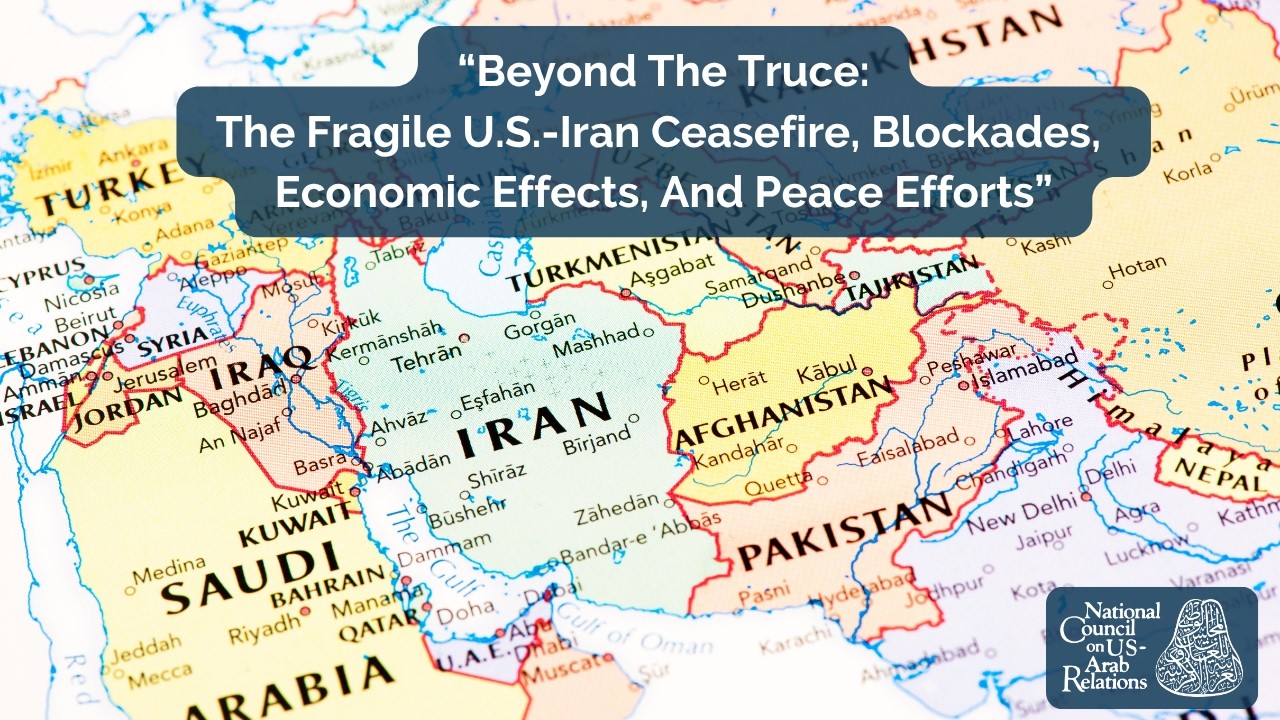
The geopolitical landscape between the U.S. and Iran remains defined by a fragile truce and a partial strategy of de-escalation for de-escalation’s sake. While no formal, signed treaty exists, both nations have operated under a quiet understanding aimed at preventing a full-scale regional war. Join us for another deep-dive into the high- stakes shadow war and tentative diplomacy defining U.S.-Iran relations. While headlines often focus on the absence of direct conflict, a complex quiet persists, governed by tacit agreements and regional maneuvering and contingent war preparation. We will analyze the unwritten rules of the current de-escalation and the dynamics of opposing blockades and maritime security sometimes referred to as the “tanker war” and its impacts on global energy security and economic performance. We will also look into the devastating effects on Iran’s economy—from triple digit inflation to the shadow oil trade with China—and how these factors influence Tehran’s negotiating position. We will then look at what comes after the truce, including evaluating the role of Pakistan as a regional mediator and the role of other countries involved in the Islamabad quartet: Turkey, Egypt, and Saudi Arabia. Our webinar will be useful for policy analysts, energy sector professionals, and anyone seeking to understand the most volatile fault line in current Middle Eastern geopolitics.
Moderator:
- Dr. Abderrahim Foukara, Former Washington D.C. Bureau Chief and Host of Min Washington, Al Jazeera | Bio
Speakers:
- Col. David Des Roches (U.S. Army Retired), Principal, Thayer Marshall Institute | Bio
- Dr. Fadi Hilani, Senior Academic and Research Fellow-in-Residence, National Council on U.S.-Arab Relations | Bio
- Dr. John Sfakianakis, Chief Economist and Head of Economic Research, Gulf Research Center, Riyadh, Saudi Arabia; Associate Fellow, Middle East and North Africa Programme, Chatham House | Bio
- Dr. Kristian Coates Ulrichsen, Fellow for the Middle East, Rice University’s Baker Institute for Public Policy; Co-Director, Middle East Energy Roundtable | Bio