For decades, United States foreign policy has viewed North Africa through a distorted lens. Frequently relegated to the periphery of the Middle East, the region has rarely commanded sustained, high-level diplomatic engagement from Washington.
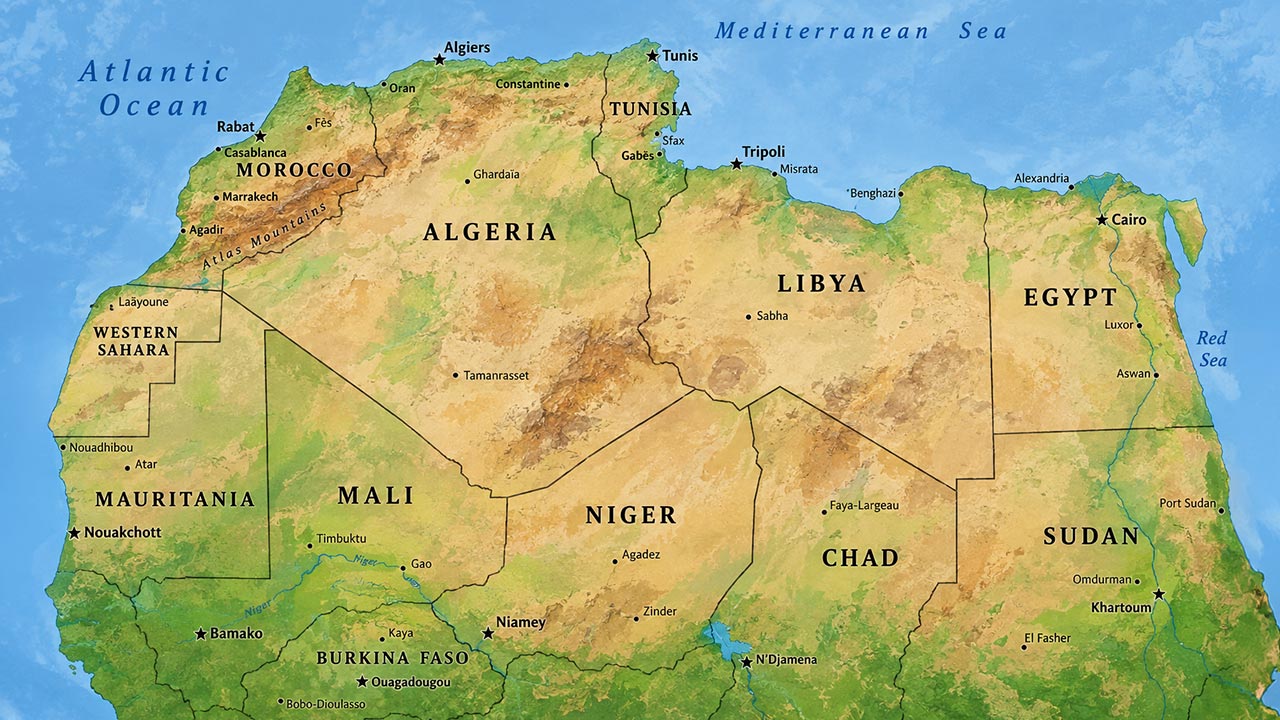
Following critical U.S. midterm elections, both the reconfigured Congress and the second Trump administration face a deeply altered geopolitical landscape across the Mediterranean’s southern rim. From the Atlantic shores of Morocco and Mauritania to the vital maritime corridor of Egypt and the divided lands of Libya and Sudan, North Africa is undergoing a profound transformation. Regional rivalries, economic deprivation, political instability, and the encroachment of predatory powers—chiefly Russia and China—have combined to create a theater of compounding crises.
For decades, United States foreign policy toward the Maghreb and the Nile Basin has fluctuated between inattention and episodic crisis management. The U.S. can no longer afford to treat North Africa as secondary. In an era of regional fragmentation and great power competition, stability in North Africa is directly tied to trade route integrity, energy market stability, and global security. By shifting from crisis management to a proactive, comprehensive strategy that bridges the gap between security assistance and economic cooperation, the United States can counter adversaries, reclaim influence, and foster a resilient global order.
The Trump administration’s foreign policy framework operates primarily through the lens of transactional realism. In this model, bilateral engagements are prioritized over multilateral institutions, and American diplomatic or security capital is deployed based on reciprocity and returns related to maritime shipping security, energy market stability, and U.S. access to resources. However, a strictly transactional approach can risk prioritizing short-term gains over long-term stability. The administration’s focus on high-impact deals—exemplified by the Abraham Accords and recent efforts with critical minerals—must be integrated into a broader strategy that addresses structural vulnerabilities. A failure to engage with deep-seated institutional decay or economic volatility leaves the door open for strategic competitors.
Following the midterm elections, the newly seated U.S. Congress can assert critical levers of foreign policy through its power of the purse and its oversight mandates. With committees reconfigured, Congress is uniquely positioned to enforce accountability on underutilized U.S. foreign assistance. Congress must exercise its oversight authority to scrutinize how U.S. funds are deployed alongside multilateral institutions like the International Monetary Fund (IMF) and the World Bank, particularly in indebted states more affected by oil price shocks like Egypt and Tunisia. By demanding rigorous, data-driven metrics for every dollar of Foreign Military Financing (FMF) and Economic Support Funds (ESF), Congress can act as a stabilizing counterweight. This approach would ensure that American engagements under the administration’s transactional framework remain aligned with enduring statutory requirements for fiscal responsibility and strategic effectiveness.
The Maghreb boasts unparalleled assets in many domains, especially its extraordinary human capital with high levels of education and professional competence. While shortfalls are routinely blamed on outsiders, the core of North Africa’s underperformance lies within the region itself, where historical animosities and grievances, institutional decay, and active state fragmentation have severely compromised integration and growth. The region is not a monolithic bloc; rather, it is a complex tapestry of states experiencing divergent political trajectories yet bound together by shared geography, culture, and vulnerabilities.
Morocco: The Anchor of Atlanticist Integration
Morocco has established itself as the primary strategic anchor for U.S. interests in the Western Mediterranean and Northwest Africa. The foundation of modern U.S.-Moroccan relations rests upon the first Trump administration’s official recognition of Morocco’s claim of sovereignty over the Western Sahara, a major diplomatic shift that reordered the region’s security architecture.
However, Morocco’s strategic value to the United States extends far beyond the Abraham Accords into growing economic and logistical capabilities. Through massive expansion of port and transportation infrastructure, Rabat is positioning itself as the maritime and terrestrial gateway connecting Sub-Saharan Africa, Europe, and the Americas. Morocco has rapidly integrated into global industrial supply chains, particularly in automobiles and aerospace. Furthermore, its extensive solar and wind installations position it to become the principal exporter of green hydrogen and clean electricity to the European Union. The recent migration crisis between Morocco and the Spanish African enclave of Ceuta—which elicited confusing U.S. reactions from critical to sympathetic—underscores the need for greater U.S. messaging discipline towards North African partners. As the host of the annual African Lion military exercises—the largest U.S. military training maneuver in Africa—Morocco remains indispensable for Africom’s operational readiness and joint interoperability.
Algeria: The Sovereign Revisionist
In contrast to Morocco’s outward-facing Atlanticist orientation, Algeria operates as a relatively restrained, sovereigntist power. Governed by a revolutionary ruling elite and sustained by hydrocarbon wealth, Algiers views aspects of the expansion of Moroccan influence in Africa and Europe and the new Israeli presence on its western border as threats to national security. The Moroccan Algerian rivalry has long severed diplomatic relations, closed the border, triggered a regional arms race, and nearly eliminated intra-regional trade.
Algeria is open to greater U.S. engagement, including weapons acquisition. Algeria has long been one of the largest global buyers of Russian military hardware, causing consternation in Congress (most adamantly expressed by Senator Ted Cruz). Algeria has nonetheless positioned itself as a staunch U.S. counterterrorism ally and a critical alternative supplier of natural gas to Europe, in direct contradiction to Russian efforts to disrupt and squeeze Europe military, politically, and economically. The September 2026 rupture of relations between Algeria and the UAE, in large part over disagreements in Niger—in addition to Algeria’s negative views on Emirati policies in Libya, Sudan, the Sahel, and Algeria—underscores the need for a more coherent U.S. strategy for the Maghreb and Sahel coordinated with regional partners.
Tunisia: Institutional and Economic Regression
Tunisia arguably boasts the region’s most highly educated, professionally competent, and cosmopolitan population. Once celebrated as the sole democratic success story of the Arab Spring with the 2016 Nobel Peace Prize awarded to four of its civil society organizations, Tunisia has experienced a reversal of fortune. Since his power grab in July 2021, President Kais Saied has partially dismantled the country’s democratic institutions, cracked down on civil society, and rewritten the constitution to centralize power in the presidency. This political consolidation has occurred alongside an economic crisis marked by high inflation and unemployment and chronic shortages of basic goods. The Tunisian state faces severe balance-of-payments challenges and ballooning sovereign debt. The government’s disinterest in implementing already agreed structural reforms required to unlock a critical IMF loan facility increases the risk of sovereign default. In exchange for financial lifelines from Algeria and the European Union, Tunis has taken on the role of a terrestrial and maritime border guard. This policy has also increased internal social tensions within Tunisia without addressing root drivers of instability. Despite all of this, Tunisia remains one of the best poised North African countries to leverage its highly educated human capital, superior entrepreneurial talent, and close relations with Europe to turn things around and succeed as it has done before.
Libya: Fragmented Sovereignty and the Militia Economy
Libya like Tunisia boasts a highly educated population, but with much less exposure to the outside world given decades of sanctions and limited access to foreign travel and education. Libyans therefore prize engagement with the outside world and particularly the U.S. more than any other Arab country. However, nearly fifteen years after the ouster of Muammar Gaddafi, Libya remains trapped in a state of fragmented sovereignty, structurally divided between competing governance architectures in Tripoli (the Government of National Unity) and Benghazi (the self-proclaimed Libyan National Army under Khalifa Haftar). This political division is reinforced by a militia predation in the east and the west that thrives on state captured revenues. The recent U.S. plan for a brokered political union broke down following strong negative reactions across Libya, notably in its third city of Misrata, and after forces under command of Haftar’s son Saddam bombed a power station and fuel depot in Western Libya.
As noted, Libya features the most pro-American Arab population and the strongest alignment with the U.S. at the United Nations. It political, business, and cultural elites were largely educated in the United States in the 1970s and 80s. It possesses Africa’s largest proven crude oil reserves, yet its oil production remains somewhat unstable. Competing factions occasionally shut down fields and export terminals as leverage to control the distribution of central bank revenues, introducing further unpredictable shocks into energy markets. The lack of central authority has allowed transnational criminal syndicates to flourish, turning pockets of Libya into transit corridors for trafficking, smuggling, and illicit arms flows. In eastern and southern Libya, the Russian state—operating through its Africa Corps—has secured access to strategic airbases (such as Al-Jufra and Ghardabiya) and the naval facility in Tobruk through deals with Haftar. This gives Moscow a permanent military foothold on the Mediterranean coastline, directly adjacent to NATO’s southern command structures, including developing a stopover port for Putin’s nuclear submarines.
Egypt: The Vulnerable Hegemon
Egypt remains an indispensable element of the Middle East and North Africa (MENA) security architecture. For this reason, Secretary of State Marco Rubio waived human rights conditions a few weeks ago on $320 million of U.S. assistance, citing Egypt’s strategic role in mediating the U.S. conflict with Iran. The released funds, part of Egypt’s $1.3 billion annual military package linked to the Camp David Accords, will be funneled into programs supporting counterterrorism, border security, and nonproliferation.
However, Egypt’s traditional role as a regional anchor is undermined by a systemic macroeconomic crisis driven by external shocks and decades of military-directed economic management and mega-project spending, limiting the development of its private sector. Egypt is currently carrying an unsustainable external debt burden. Despite recent multibillion-dollar financial injections from the United Arab Emirates (including the Ras El Hekma deal) and expanded support from the IMF, the Egyptian economy remains fragile, marked by elevated inflation and high borrowing costs that pressure the social safety net. Seeking alternatives to Western-dominated financial systems, Egypt officially joined the BRICS bloc. This shift reflects a broader strategy to diversify its geopolitical dependencies and access non-Western capital, even as it remains one of the largest historic recipients of U.S. Foreign Military Financing. The Suez Canal, a key source of Egypt’s foreign currency reserves, faces ongoing revenue losses due to security threats in the Red Sea. Concurrently, China has expanded its economic presence within the Suez Canal Economic Zone and secured significant stakes in major Egyptian ports like Alexandria and Damietta, integrating Egypt into its Maritime Silk Road.
Sudan: State Collapse and the Red Sea Geopolitics
The ongoing civil war between the Sudanese Armed Forces (SAF) and the Rapid Support Forces (RSF) has caused a severe humanitarian crisis and led to a catastrophic fragmentation of the state and a volatile space where multiple regional powers compete for influence. Both the SAF and RSF have engaged in transactional diplomacy with foreign actors, offering access to Sudan’s strategic coastline. Moscow has long sought a permanent naval logistics facility at Port Sudan, a move that would extend Russia’s naval presence into the Red Sea shipping lanes. The Russian Africa Corps network in Libya and the Central African Republic has historically facilitated logistics that cross into Sudanese territory, demonstrating the interconnected nature of these regional conflicts.
The war has displaced millions both internally and into neighboring countries like Egypt, Chad, and South Sudan. This massive movement of people risks destabilizing border zones and overwhelming the capacity of surrounding states to manage the crisis. The re-eruption of the Ethiopian civil war in recent weeks is not helping, pushing even more refugees into Sudan and through Sudan to other destinations.
Mauritania: The Fragile Sahelian Bulwark
The strategic boundary between the Maghreb and the Sahel is artificial; in reality, the two regions are bound by a shared security-development nexus. Mauritania stands as a critical, yet highly fragile, geographic bridge connecting the Maghreb with the unstable Sahelian littoral. As neighboring states have succumbed to military coups and civil conflict, Nouakchott has maintained institutional stability, making it a willing and essential partner for Western security strategies. The collapse of the G5 Sahel framework and the withdrawal of French-led military forces from Mali have left Mauritania directly exposed to the spillover of insurgent violence and cross-border criminal networks.
Mauritania hosts a large and growing population of refugees fleeing conflict in Mali. This rapid displacement places severe strain on the limited social infrastructure of its fragile border regions, risking local friction and social instability. The development of the Greater Tortue Ahmeyim (GTA) LNG project, shared with Senegal, offers Mauritania an opportunity to transform its economic profile and emerge as a new energy exporter to European markets. Protecting these offshore energy investments requires enhanced maritime security capabilities that Nouakchott cannot field alone.
Russian and Chinese Opportunism in the Maghreb, Sahel, and Nile Basin
The Sahelian belt that stretches from Mali through Burkina Faso to Niger has experienced a structural collapse of constitutional governance, marked by a series of military coups assisted by Russia and the rapid expansion of violent extremist organizations aligned with Al-Qaeda and the Islamic State. The forced expulsion of Western forces, including the loss of U.S. drone operations in Agadez, Niger, has significantly reduced Washington’s counterterrorism capabilities and limited intelligence collection across the region.
Putschist governments in Mali, Burkina Faso, and Niger have broken away from traditional regional bodies like ECOWAS to form the Alliance of Sahel States. These regimes have actively turned away from Western security partnerships in favor of direct security support from Moscow. Russia’s security model in the Sahel relies on providing praetorian regime protection to military juntas in exchange for direct access to valuable natural resources, particularly gold, uranium, and lithium. This predatory framework focuses on securing immediate financial returns and political influence rather than addressing the structural drivers of local radicalization or economic underdevelopment. The extraction of gold from Sudan and Mali, alongside diamond and mineral assets in Central Africa, also provides an alternative revenue stream that helps Moscow mitigate the impact of Western financial sanctions. Russia’s ongoing efforts to secure long-term naval access in Tobruk, Libya, and Port Sudan, alongside its active use of airbases in central Libya, serve a clear strategic purpose. These installations allow Moscow to position assets capable of challenging maritime movements and air traffic across the Mediterranean and Red Sea corridors.
While Russia emphasizes asymmetric military access, the People’s Republic of China pursues long-term geoeconomic integration through its Belt and Road Initiative (BRI), specifically focusing on the Digital Silk Road and Maritime Silk Road frameworks. Beijing’s strategy aims to build deep, structural economic dependencies that can be converted into long-term geopolitical leverage. Chinese state-owned enterprises, such as COSCO Shipping and China Merchants Port Holdings, have systematically acquired equity stakes and operational concessions in major commercial ports along the North African coastline. These investments span from Tanger Med in Morocco to Alexandria and Damietta in Egypt, giving Beijing significant influence over critical trade links connecting Asia with European markets. Through the deployment of Huawei and ZTE 5G networks, China has constructed the primary digital backbone for public administration, financial services, and cellular communications across much of North Africa. This widespread digital presence raises long-term data security and intelligence risks for Western state interactions within the region. In indebted economies like Egypt and Tunisia, Chinese state financial institutions offer alternative credit lines and infrastructure loans outside the strict transparency requirements of traditional lenders like the IMF. This lack of structural conditioning gives Beijing significant leverage to reshape local regulatory frameworks and secure preferential access to domestic markets.
A Four-Pillar North Africa Engagement Strategy
To counter the expansion of adversarial influence, protect critical maritime choke points, and stabilize NATO’s southern flank, the United States must implement a resource-aligned strategy, divided into four pillars encompassing diplomatic and economic engagement, incentivized institutional reform, and counterterrorism cooperation. This approach should integrate the transactional realism of the executive branch with the fiscal discipline and oversight mandates of the Congress.
Pillar I: Active Diplomatic Mediation and Pragmatic Realism
The State Department must revitalize its diplomatic engagement in North Africa, deploying high-level envoys to actively manage the political rivalries that drive regional instability. The Trump administration should begin by enhancing diplomatic channels with both Algiers and Rabat. The administration and Congress should avoid getting entangled in the Saharan dispute, especially by alienating Algeria. Instead, the U.S. should promote security cooperation with both Algeria and Morocco focused on the deadliest terrorist threats like ISIS- and Al Qaida-affiliated armed groups, mostly to the south. U.S. diplomacy should also focus on building pragmatic, de-escalatory agreements around border security and counterterrorism coordination to reduce the risk of a worsening the bilateral conflict and assist with the brokering of and incentivizing a Morocco-Polisario ceasefire.
Similarly, the U.S. should continue to work alongside the United Nations to support a unified legal and electoral framework for Libya. It should avoid playing kingmaker for ruling family members from east or west, a new policy that Trump’s Africa Envoy Massad Boulos promised earlier this month to the new Libyan chief diplomat in Washington. Realists have good reason to avoid picking sides in the various Libyan divides. One reason is that Haftar’s regime is highly centralized around him, and his two sons, Saddam and Khaled, are currently feuding over who will succeed the elderly patriarch and who will get what position if the government unifies. Diplomatic engagement should focus on creating transparent mechanisms for auditing and distributing oil revenues through the Central Bank of Libya to reduce the financial incentives for militia violence.
In Sudan, the U.S. must work alongside regional partners in the Gulf and Africa to enforce strict arms embargoes and compel the warring generals to accept sustained humanitarian access and ceasefire negotiations. In Congress, the U.S. should reconcile the significant differences between the House-proposed U.S. Engagement in Sudanese Peace Act and the Senate-proposed PEACE in Sudan Act. U.S. efforts should prioritize restoring humanitarian assistance, including honoring its February 2026 pledge of $200 million in humanitarian assistance. The U.S. should prioritize establishing and protecting humanitarian corridors to Sudan’s 16 million IDPs and an additional 4 million IDPs across the Sahel.
Pillar II: Energy Statecraft and Geoeconomic Partnerships
The United States should leverage its financial and technical advantages to build deeper economic integration with North African energy sectors, offering a transparent, market-driven alternative to China’s state-backed infrastructure models. Greater U.S. investments in the energy sector will benefit from the regional preference for American technology over all others. The U.S. International Development Finance Corporation (DFC) should also expand its capital commitments for large-scale solar, wind, and green hydrogen projects in Morocco, Mauritania, and Egypt, to meet large regional and European demand for green energy. These investments should be tied to requirements for local procurement and supply chain transparency. The U.S. should deploy technical advisors through the Department of Energy to help partner nations modernize their electrical grids and implement regulatory reforms. This work can create predictable legal environments that attract private American venture capital into regional energy projects. The U.S. should establish bilateral commercial partnerships focused on the responsible exploration and processing of critical minerals, particularly in Mauritania and Morocco, to help diversify global tech and energy supply chains away from Chinese monopolies.
Pillar III: Better Conditioned and Incentivized Security Assistance and Institutional Accountability
The post-midterm Congress must use its appropriations authority to transition U.S. security assistance away from unconditional grants to helpful allies and toward a structured framework based on performance, accountability, and clear strategic alignment. The U.S. should tie a fixed percentage of Foreign Military Financing and Economic Support Funds for Egypt and Tunisia to verifiable progress in specific governance metrics, including anti-corruption measures, judicial independence, and security sector accountability. The U.S. should also prioritize funding for defensive, non-force-projection capabilities—such as coastal radar surveillance networks, maritime interdiction equipment, and border monitoring technologies—to help partner nations counter illicit trafficking and secure critical shipping lanes. The U.S. should collaborate with European partners and the International Monetary Fund (IMF) to structure a comprehensive economic rescue and stabilization packages for Tunisia and Egypt. By cushioning the economic blow for ordinary citizens while holding the executive accountable, the U.S. can mitigate against negative economic and political outcomes that could exacerbate Europe’s illegal migration woes.
Pillar IV: Sahelian Containment and Bulwark Stabilization
To manage the security challenges resulting from the French-led withdrawal of forces from the Sahel, the United States must focus on strengthening the defense and governance capabilities of the states bordering the conflict zones. The U.S. should increase security cooperation and intelligence-sharing operations with stable littoral and frontline states, such as Mauritania, Morocco, Algeria, Tunisia, Senegal, and Côte d’Ivoire, to help prevent the northward expansion of Sahelian insurgent networks.
It should deploy targeted State Department stabilization funds to reinforce local governance, improve water security, and build basic economic infrastructure in fragile border regions, addressing the local grievances that extremist recruiters exploit. Congress should work to revitalize the Trans-Sahara Counterterrorism Partnership (TSCTP) by operationalizing the conclusions of the 2025 audit. The new Congress should push for cooperating with U.S. allies on security capacity-building, training, and professionalization, a far cheaper alternative to direct military intervention when terrorism surges. The U.S. should also expand public diplomacy initiatives and digital media engagement to actively counter Russian and Chinese disinformation campaigns, highlighting the long-term sovereign costs associated with predatory security partnerships and unsustainable debt-driven infrastructure deals.
Conclusion
Hopefully, the era of treating North Africa as an afterthought is over. The geopolitical tectonic plates have shifted. The combination of great power competition, structural regional divisions, and macroeconomic distress has transformed the southern Mediterranean into a critical theater of strategic risk and opportunity. The post-midterm political landscape provides the United States with a distinct window to shift from a reactive posture to a proactive, comprehensive strategy. The combination of the transition toward a focused, outcome-driven executive framework and Congress’s emphasis on fiscal accountability can be unified into an effective policy framework. By implementing this four-pillar North Africa engagement strategy, Washington can counter adversarial influence, secure vital global maritime corridors, protect strategic energy supply chains, and reinforce NATO’s southern flank. This strategy does not require massive military interventions or trillions of dollars in open-ended nation-building. Instead, it demands strategic clarity, proactive diplomatic engagement, and targeted economic investments that leverage America’s greatest strengths: private sector innovation and dynamism, technological superiority, and unmatched institutional capacity.
National Council on U.S.-Arab Relations fall interns Suzanne Slovak, Joseph Clark, and Asher Josef contributed to the research for this article. Dr. William Lawrence has worked on the Maghreb academically and professionally for over three decades, including as North Africa lead at the Council, at Crisis Group, at Control Risks, and in several State Department offices. There he worked directly on the 2005 creation of the Trans-Sahara Counterterrorism Partnership. The views expressed in this article belong solely to the author and do not necessarily reflect the views of the National Council.