
The regional order that has defined the Middle East for much of the past two decades is undergoing a profound transformation. The current U.S.–Iran conflict has accelerated this process, weakening established patterns of influence and creating new strategic space for regional actors to redefine their roles and relationships. Nowhere is this shift more consequential than in Syria, where the end of Assad’s rule has fundamentally altered a regional landscape long shaped by the Damascus–Tehran alliance.
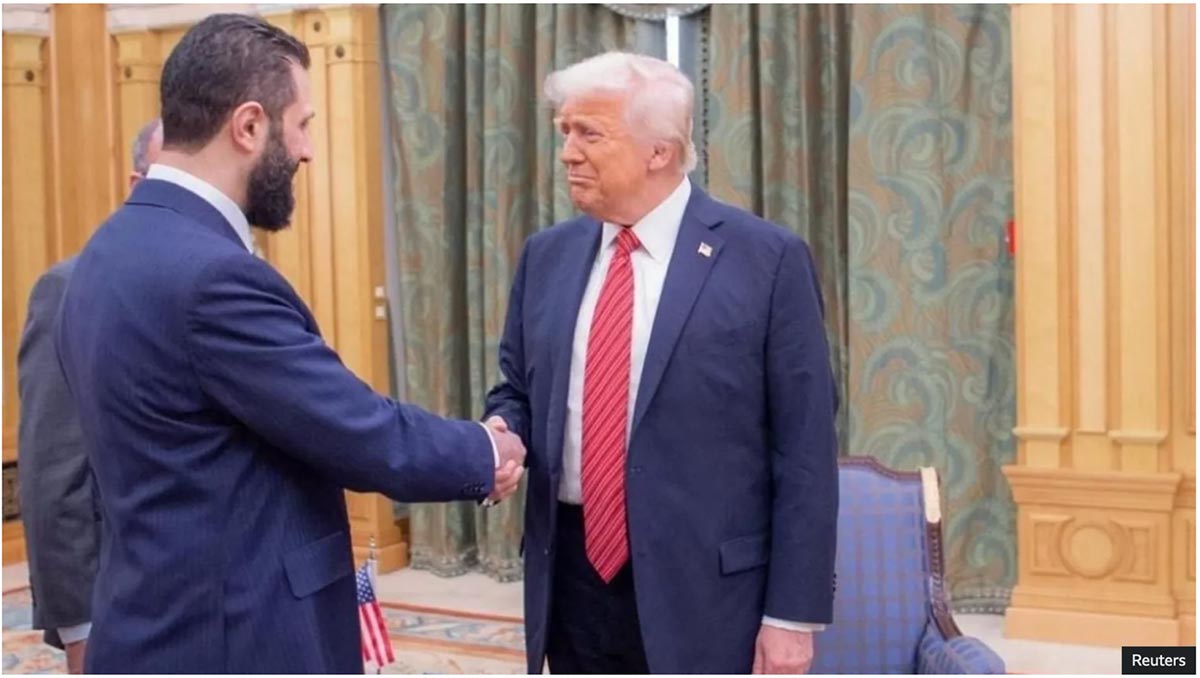
President Donald Trump’s recent remarks suggesting that Syria under President Ahmad al-Sharaa could play a larger role in addressing Hezbollah should not be interpreted as a proposal for Damascus to replace Israel militarily. Rather, they reflect a broader strategic recalibration that has gradually emerged in Washington since the collapse of the Assad regime. The objective is not to transform Syria into another full-fledged military partner similar to Israel, Egypt, or Jordan, but to integrate a post-Assad Syria into a regional security architecture that weakens Iranian influence while reducing the need or pretext for repeated Israeli military operations into Syria and Lebanon.
This distinction is important because much of the public debate has focused on Trump’s rhetoric rather than the strategic logic behind it. In reality, neither the White House nor most of Washington’s policy community believes Syria possesses the military capacity, political legitimacy, or strategic interest to wage a campaign against Hezbollah. Instead, the expectation is considerably more modest—and arguably more realistic. If Damascus can secure its own territory, control its borders, prevent the transfer of advanced weapons into Lebanon, and distance itself from Iran, it would already accomplish one of the United States’ primary strategic objectives in the Levant.
Syria’s greatest value to Washington lies not in military intervention but in geography. Syria remains the indispensable land bridge connecting Iran to Lebanon. For decades, Tehran relied on Syrian territory to transport precision-guided missiles, drones, rocket components, and military advisers to Hezbollah. If the new Syrian government successfully reasserts sovereignty over its western and eastern borders, much of Iran’s logistical infrastructure would become significantly more difficult to sustain. In other words, Washington is less interested in Syria fighting Hezbollah than in preventing Hezbollah from being resupplied through Syrian territory. This represents a strategy of containment rather than overt confrontation.
The significance of geography cannot be overstated. Throughout the Syrian civil war, Iran invested enormous financial and military resources to preserve supply corridors stretching from Iraq through Syria into Lebanon. Even after the weakening of Iranian-backed militias and the collapse of the Assad government, Tehran continues to rebuild portions of these logistical networks through tribal intermediaries, local armed groups, and clandestine smuggling routes. The United States therefore sees border control as not just as a law enforcement issue but as a strategic capacity. Every successful Syrian effort to reduce illicit cross-border movements directly contributes to the broader American objective of limiting Hezbollah’s military modernization.
President Ahmad al-Sharaa appears to understand this strategic calculation. His recent public statements regarding Hezbollah have been remarkably restrained. Rather than advocating military confrontation, he emphasized dialogue if such engagement serves both Syrian and Lebanese interests. From Damascus’ perspective, this approach reflects political realism rather than ideological moderation. Syria has emerged from more than a decade of devastating conflict with depleted military institutions, enormous reconstruction needs, and limited financial resources. Opening another front in Lebanon would undermine precisely the international legitimacy and regional partnerships that the new Syrian government is attempting to build.
This position also reflects an important historical lesson. Syrian policymakers recognize that any direct military involvement in Lebanon would inevitably revive memories of Syria’s decades-long military presence and political dominance there. Such a move would alarm many Lebanese political actors, weaken Arab support for the new Syrian leadership, and complicate relations with Western governments that have cautiously welcomed Syria’s political transition. Consequently, Damascus increasingly presents itself not as Lebanon’s security manager, but as a neighboring state interested in stable borders, functioning institutions, and regional economic integration.
This strategic restraint also aligns with a broader current of thinking within Washington’s policy community. Rather than expecting Syria to confront Hezbollah militarily, the more sustainable way to reduce Iranian influence is by strengthening the Syrian state itself. From this perspective, Syria’s greatest contribution to regional security is not projecting military power beyond its borders, but restoring effective governance, rebuilding its economy, reestablishing control over its frontiers, and becoming less dependent on external patrons. This logic explains why the Trump administration’s decision to terminate broad U.S. sanctions is viewed not simply as an economic measure, but as part of a wider geopolitical strategy to encourage Syria’s reintegration into the Arab and global orders.
Today, Syria is increasingly viewed through the wider framework of regional competition with Iran, not only as a security arena but also as a potential strategic corridor capable of reshaping the region’s economic and energy geography. This is where the emerging Four Seas Initiative becomes particularly significant. The initiative envisions connecting the Persian Gulf and the Caspian, Mediterranean, and Black Seas through interconnected energy, transportation, electricity, and communications networks, with Syria and Türkiye positioned at the center of the proposed corridor. Syria’s geographic position gives it a particularly important role: it can potentially connect Gulf and Iraqi resources through Jordan and Syria to the Mediterranean and onward through Türkiye toward European markets, making Syrian territory a strategic bridge between the Arab Gulf, Iraq, the Eastern Mediterranean, and Europe.
From a U.S. strategic perspective, therefore, supporting Syria’s stabilization and economic reconstruction is also a means of creating an alternative regional architecture less dependent on Iranian-controlled networks and vulnerable maritime chokepoints. The Four Seas concept consequently elevates Syria’s importance beyond its traditional role as a Levantine security arena: a stable, sovereign, and economically integrated Syria could become a critical node in a broader U.S.-backed effort to connect regional markets, diversify energy routes, attract Gulf investment, and reduce Iran’s ability to use geography and infrastructure as instruments of regional influence.
Against this backdrop, security will remain a central pillar of the emerging U.S.-Syria relationship, even as Washington had withdrawn its military presence from Syria. The key distinction, however, is between a U.S. military presence and a U.S. security role, which underpins a shift from direct military engagement to a security-partnership model in which the Syrian government assumes primary responsibility for securing its territory, while the United States could provide intelligence, training, technology, and institutional support from outside the country. This approach would allow Washington to address the principal security challenges of post-Assad Syria—including the resurgence of ISIS, remnants of the former regime, and Iranian efforts to use Syrian territory as a logistical corridor for transferring weapons to Hezbollah—without becoming indefinitely responsible for Syria’s internal security. In this sense, U.S. withdrawal can mark a transition from direct intervention to strategic enablement, with Washington seeking to build Syrian capacity to address threats that ultimately affect both Syrian stability and broader U.S. interests in the region.
This means Washington should help build a professional Syrian counterterrorism and internal-security architecture, which could include intelligence-sharing, training in counterterrorism, border security, bomb disposal, cyber capabilities, financial intelligence, and protection of critical infrastructure. U.S. assistance should also help Damascus establish mechanisms for intelligence fusion and early warning against ISIS cells and remnants of the former regime, and mechanisms for coordinating with Iraq, Jordan, Lebanon, Turkey, and the GCC states. The broader objective should be to transform Syria from an Iranian logistical corridor under Assad into a sovereign state capable of controlling its borders. The integration of Kurdish forces and other former armed formations into national institutions is particularly important: if this process produces a genuinely unified Syrian security structure, it can prevent the fragmentation that previously allowed ISIS and other armed groups to exploit security vacuums. Recent developments—including the appointment of former SDF commander Mazloum Abdi as an adviser to President al-Sharaa—suggest that Washington still has an opportunity to encourage reconciliation and institutional integration.
However, Washington cannot expect the al-Sharaa government to establish legitimacy and consolidate state authority if Israel is simultaneously able to operate militarily inside Syrian territory with limited constraints. Israeli concerns about Iranian weapons transfers, Hezbollah, terrorism, and Syrian military capabilities are legitimate from a U.S. perspective, but continued unilateral Israeli incursions risk producing the opposite of the intended outcome: weakening Damascus, undermining the credibility of the new government, and allowing its domestic opponents to portray it as incapable of defending Syrian sovereignty. This concern is particularly acute given the recent expansion of Israeli military activity in southern Syria and the UN commission’s characterization of some Israeli actions as potentially constituting violations of international law.
Therefore, Washington should use its leverage with Israel to establish clear limits on unilateral military action in Syria. This does not mean necessarily asking Israel to abandon security concerns; rather, the United States should insist that strikes and ground operations be subject to a credible notification and deconfliction mechanism, with military action reserved for clearly defined and imminent threats. The United States is already attempting to establish such a mechanism among Israel, Syria, and Turkey, and U.S.-mediated Syrian-Israeli talks in Jordan have focused specifically on stopping Israeli operations and reviving a security arrangement. The next step should be to make the mechanism politically consequential: Washington should press Israel to return to agreed lines, halt the establishment of permanent military positions inside Syria, and address its security concerns through intelligence-sharing and negotiated security zones rather than repeated unilateral strikes.
Likewise, Washington’s effort to reinforce Syrian sovereignty cannot be separated from the security environment on its western border. If the United States seeks to prevent Syria from again becoming a conduit for Iranian power projection, it must also address the networks that connect Syrian territory to Lebanon and, through Lebanon, to Hezbollah. Lebanon’s security is therefore not a separate policy concern but an extension of the broader effort to consolidate post-Assad Syria: the two countries share a long and porous border through which weapons, militants, and illicit networks can move, while instability in Lebanon can generate direct security pressures on Syria. For this reason, Washington should redouble their efforts to strengthen the Lebanese Armed Forces (LAF) as the legitimate security actor on the Lebanese-Syrian border and in southern Lebanon, helping Beirut dismantle Hezbollah’s military and logistical networks that can also threaten Syria’s border security and facilitate the movement of weapons from Iran through Lebanon. U.S. assistance should focus on intelligence-sharing, border surveillance, counter-smuggling capabilities, communications, training, and equipment that enable the LAF to progressively assume control of areas currently contested by Hezbollah.
This should be paired with a diplomatic effort to curb Israeli military incursions into southern Lebanon: Washington should make clear that Israeli withdrawal and restraint are essential to the success of the U.S.-backed process because continued Israeli military presence allows Hezbollah to portray itself as Lebanon’s necessary defender and simultaneously weakens the LAF’s credibility. The fighting around Ali al-Taher illustrates the dilemma: the United States has sought to have Hezbollah relinquish strategic positions to the Lebanese army, while Israeli operations and continued territorial control complicate the LAF’s ability to assume that responsibility.
The U.S. objective, therefore, should be a reciprocal security bargain: Washington helps the LAF establish a state monopoly over armed force and secure the Lebanon-Syria border, while using its considerable leverage with Israel to facilitate a phased withdrawal from Lebanese territory, supported by verification and security guarantees. Such an approach would simultaneously weaken Hezbollah’s justification for maintaining an independent military infrastructure, reinforce the Lebanese state’s legitimacy, and reduce the risk that instability or Iranian weapons networks operating through Lebanon spill back into Syria.
This outcome would also serve Syria’s own security interests. Damascus has a strong interest in preventing Hezbollah from rebuilding its military capabilities in the aftermath of the current conflict with Israel and re-emerging as an armed actor capable of threatening Syrian sovereignty or destabilizing the country. In this sense, strengthening Lebanon’s state capacity and securing its borders would form part of the same U.S. strategy of consolidating Syrian sovereignty and preventing Iran from reconstructing the interconnected security networks that once gave it strategic depth across the Levant.
More broadly, the question facing Washington is what role a post-Assad Syria is expected to play in the regional order emerging from the ongoing conflict between the US and Iran. Within this context, Syria occupies a uniquely important strategic position. Geography makes Syria the critical junction between Iraq and Lebanon and, historically, the most important transit corridor through which Iran projected power into the eastern Mediterranean. Consequently, the future of Syria has become intertwined with broader efforts to redefine the regional balance of power after the war. Washington increasingly views a sovereign, stable, and economically integrated Syria not as an anti-Iranian frontline state, but as a state capable of restoring the primacy of national institutions over transnational military networks. The goal is not necessarily to sever all relations between Damascus and Tehran, which would likely prove unrealistic and counterproductive, but to ensure that Syrian territory no longer serves as an unrestricted platform for Iranian military projection. In this sense, American support for Syria’s rehabilitation is part of a wider regional strategy that seeks to build a new Middle Eastern architecture: one that encourages coexistence and negotiated understandings with Iran in the Gulf, while limiting Tehran’s ability to shape political and security outcomes in Iraq, Syria, and Lebanon through armed non-state actors. The future of Syria, therefore, is increasingly linked not only to bilateral U.S.-Syrian relations but also to the broader post-war effort to redefine the rules, geography, and instruments of influence across the Middle East.