Click Here to Watch LIVE on YouTube
Monday, July 20, 2026
1:00 p.m. – 2:00 p.m. / Eastern Time
Registration is NOT REQUIRED to view the program.
Submit questions to the specialists: questions@ncusar.org
Background and Context
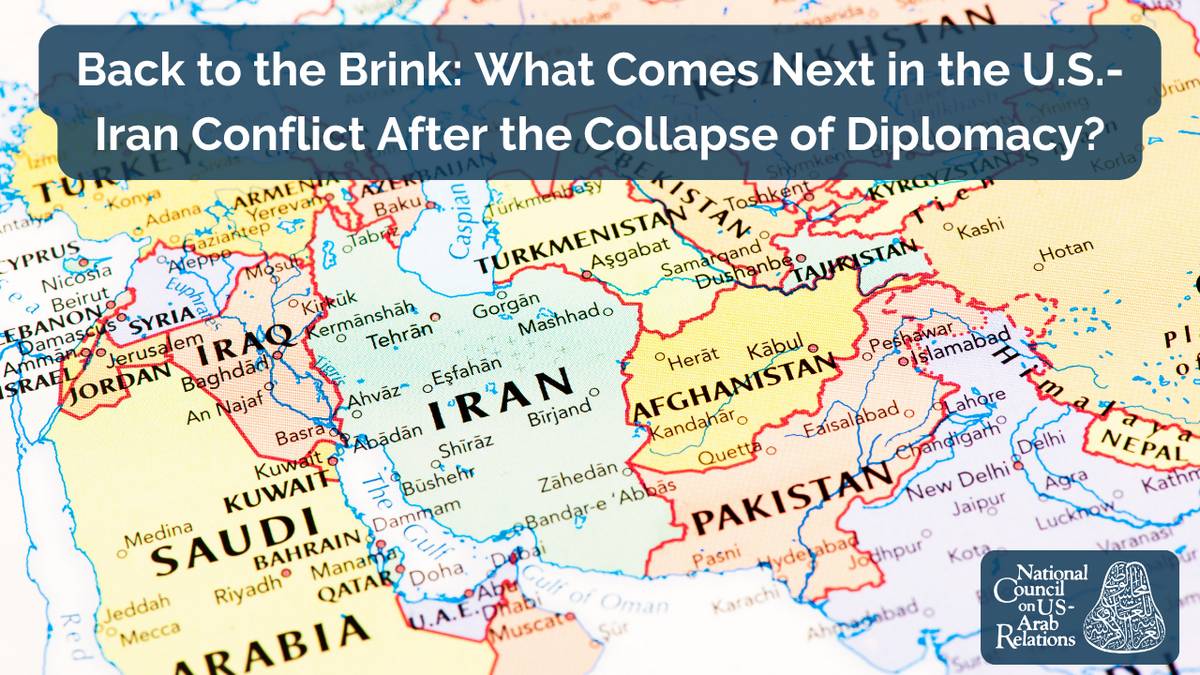
The renewed U.S.-Iran confrontation has pushed the Middle East into a moment of profound uncertainty, where military escalation, strategic competition, and diplomatic calculations are converging in ways that could reshape the region for years to come. As Washington seeks to restore deterrence and protect regional stability, Tehran continues to test the limits of pressure, resilience, and retaliation, while the Gulf and the broader international community confront the risks of a crisis that extends far beyond the immediate battlefield. At the center of this unfolding struggle are critical questions about the future of Gulf security, the credibility of U.S. commitments, Iran’s regional strategy, the role of international actors, and the possibility of returning to diplomacy after a dangerous cycle of escalation.
This timely webinar brings together leading experts to examine the multiple dimensions of the crisis—from the strategic calculations shaping Tehran’s decisions, to the regional implications for Gulf security and energy markets, to the broader impact on global stability and the international order. Is this confrontation a temporary escalation or the beginning of a new era of strategic competition? Can a sustainable framework for security and diplomacy emerge from the current crisis? And will the next phase be defined by negotiation, containment, or a wider conflict that transforms the balance of power in the Middle East?
The discussion will provide a comprehensive assessment of the forces driving this crisis and the choices facing regional and global stakeholders at a critical juncture. By bringing together diverse perspectives and strategic insights, the webinar aims to illuminate the pathways that could either stabilize the region or deepen an already volatile geopolitical environment.
Welcoming and Introduction:
- Dr. Fadi Hilani, Director of the Levant and Middle East Area Studies Program, Senior Academic and Research Fellow-in-Residence, National Council on U.S.-Arab Relations | Bio
Moderator:
- Dr. Abderrahim Foukara, Distinguished Fellow for U.S.-Arab Affairs and Media Leadership, National Council on U.S.-Arab Relations; Former Washington D.C. Bureau Chief, Al Jazeera | Bio
Speakers:
- Amb. Joey Hood, Former Acting Assistant Secretary, Near Eastern Affairs Bureau, State Department; Former Consul General and Principal Officer, U.S. Consulate, Dhahran, Saudi Arabia; Former U.S. Ambassador to Tunisia | Bio
- Dr. Joseph Kechichian, Senior Research Fellow at the Office of the Chairman, King Faisal Center for Research and Islamic Studies, Riyadh | Bio
- Dr. Kristian Coates Ulrichsen, Fellow for the Middle East, Rice University’s Baker Institute for Public Policy; Co-Director, Middle East Energy Roundtable | Bio