
The Trump administration’s Middle East policy has been structured around three mutually reinforcing tracks. First, it has sought to resolve long-standing conflicts in the region—most notably the Arab–Israeli conflict—through active diplomacy and the pursuit of negotiated political settlements, while simultaneously advancing regional normalization through the expansion of the Abraham Accords. Within this framework, conflict resolution and normalization have been central to the administration’s effort to reshape regional alignments, strengthen security cooperation between Israel and Arab states, and promote economic integration as a foundation for a more stable and interconnected Middle East. Second, the administration has pursued a strategy of maximum pressure on Iran aimed at constraining Tehran’s nuclear ambitions, curbing its regional influence, and deterring its destabilizing activities, while explicitly keeping the military option on the table as an instrument to reinforce diplomatic and economic pressure. Third, the administration has emphasized a sustained counterterrorism strategy focused on the enduring defeat of ISIS, prioritizing intelligence cooperation, targeted military operations, and partnerships with local and regional actors to prevent the group’s resurgence, disrupt its networks, and ensure that weakly governed spaces do not once again become platforms for transnational terrorist threats.
Syria and Lebanon sit at the crossroads of this policy, occupying a pivotal place in the Trump administration’s broader Middle East strategy. For decades, both countries—historically adversarial states to Israel and the site of ongoing Israeli occupation of territory in each—have functioned as key nodes of Iranian influence in the Levant, facilitated by Tehran’s deep political, military, and security penetration of the Assad regime in Syria and by its extensive financial, logistical, and ideological backing of Hezbollah in Lebanon. Through these relationships, Iran has entrenched a forward presence along Israel’s borders and consolidated Hezbollah as its most powerful non-state proxy, a militia that defines its mission as “resistance” to Israel and positions itself as a central actor opposing Israeli military and political influence in the region.
Further, Syria under the Assad regime became an inadvertent hub for ISIS’s growth, shaped by strategic decisions with far-reaching consequences for the Syrian uprising and the region. While Damascus publicly framed itself as a bulwark against terrorism, the regime strategically released hundreds of hardline Islamist prisoners in the early stages of the conflict—most notably through Decree No. 61 in May 2011—including detainees from Sednaya prison who later became senior figures in ISIS and other jihadist groups, thereby radicalizing segments of the opposition. In many cases, the regime refrained from targeting ISIS strongholds or tolerated their expansion, allowing the group to focus attacks on moderate rebels rather than government forces, with some ISIS movements aligning tactically with regime interests. Additionally, Syrian economic and financial networks continued to operate in ISIS-controlled areas, indirectly supporting the group’s access to resources. This selective engagement enabled Assad to portray the conflict internationally as a fight against terrorism, weakening external support for moderate opposition forces while ISIS’s expansion simultaneously fragmented anti-regime opposition and reinforced the regime’s narrative of existential threat.
The expansion of ISIS and the Syrian conflict had major spillover effects in Lebanon, straining its fragile security and social fabric. Extremist fighters infiltrated border areas, triggering terrorist attacks and clashes, such as the Tripoli bombings, which heightened sectarian tensions and forced the Lebanese Armed Forces to counter militant networks. ISIS-affiliated militants contributed to instability along the Lebanon–Syria frontier, deepening divisions between Sunni communities and Hezbollah-aligned Shiite areas. The war also triggered massive refugee inflows—over a million people—straining public services, altering demographics, and providing conditions for extremist recruitment, with Lebanese authorities recently reporting arrests of ISIS-linked cells planning attacks in Beirut and other areas.
With Hamas’s October 7 attacks on Israel— which triggered Israel’s war in Gaza and an expansive seven-front military campaign against Palestinians and Iran’s regional proxy network—significant realignments in the regional balance of power emerged, creating strategic inflection points and political openings in Syria and Lebanon that dovetail with President Trump’s broader objectives. In Syria, the collapse of the Assad regime in December 2024 marked a watershed moment, opening space for engagement with a new political leadership seeking international legitimacy, economic recovery, and security. This transition presents an opportunity for the United States and its partners to cooperate with the new Syrian authorities to roll back Iran’s entrenched influence, disrupt remaining terrorist networks, and support the reconstruction of state institutions in ways that reduce the appeal of militias and external patrons. In Lebanon, likewise, the election of a new president in January 2025 on a platform centered on restoring state sovereignty and monopolizing weapons in the hands of the government offers a chance for recalibrated U.S.–Lebanese relations. If pursued seriously, this agenda could constrain Hezbollah’s autonomous military role, diminish Iran’s political and security leverage, and enable Lebanon to re-anchor itself in the Arab and international systems.
Together, these developments enhance the prospects for drawing both Syria and Lebanon into a reconfigured regional order—potentially including, over time and under appropriate conditions, participation in the Abraham Accords—thereby advancing conflict resolution, weakening Iran’s regional posture, and reinforcing President Trump’s self-styled role as a global peacemaker.
Notwithstanding this potentially favorable strategic moment, the governments in Damascus and Beirut continue to confront profound and interrelated challenges in rebuilding effective state authority. Both face the arduous task of state-building after years of conflict and institutional erosion, including restoring credible governance, reviving economies under severe strain, and reconstituting professional security institutions capable of operating under unified civilian control. Central to these challenges is the effort to monopolize the use of force, as armed non-state actors, legacy militias, and fragmented security structures continue to limit the state’s ability to exercise exclusive authority over territory and decision-making.
In Syria, decades of Assad family rule profoundly corroded state institutions through pervasive corruption, nepotism, and the politicization of core governance structures. The judiciary was controlled by the president and security services, who used terrorism laws and courts to suppress dissent through detentions and enrich themselves through bribes. Basic services and legal processes were routinely manipulated to extract payments or reward loyalists, eroding public trust and accountability. The security apparatus—particularly the mukhabarat and elite units like the 4th Armored Division under Maher al-Assad—was deeply embedded in illicit economies such as the multi-billion-dollar captagon trade, which generated hard currency, financed militias, and shaped patronage networks that prioritized loyalty over competence. This systemic decay left ministries weak, fragmented, and subordinate to regime survival rather than public administration. In the wake of Assad’s fall, these structural weaknesses have been exacerbated by remanent loyalist militias, such as the Coastal Shield Brigade, which resumed operations in 2025 to resist the transitional government in western Syria. They have also been exacerbated by the persistent threat posed by ISIS-affiliated cells, evidenced by high-profile attacks like the June 2025 suicide bombing at the Mar Elias church in Damascus. This highlighted how extremist networks continue to exploit security vacuums and undermine stabilization efforts. On December 13, 2025, an ambush near the ancient city of Palmyra claimed the lives of two U.S. Army soldiers and their American civilian interpreter as part of a joint counter-ISIS operation, underscoring that Islamic State remnants remain capable of lethal assaults and can impact both local security dynamics and international counterterrorism missions.
In Lebanon, pervasive state corruption—particularly within the banking and financial sectors—has been a central driver of the country’s deep economic and currency crisis, underscoring the urgent need for comprehensive reform and the restoration of public trust. State institutions, including the central bank (Banque du Liban), colluded with politically connected elites to implement unsustainable financial practices, such as offering high interest rates to attract foreign deposits and channeling them into government debt rather than productive investment, inflating public debt and masking systemic insolvency. When capital inflows declined, banks imposed informal capital controls in 2019, freezing dollar deposits and precipitating a 90 % devaluation of the Lebanese pound. Corruption scandals, including investigations into central bank governor Riad Salameh, exemplify the state’s role in mismanagement, while reform efforts—such as modifying banking secrecy laws to enable audits and secure IMF support—have been hindered by entrenched political and institutional resistance. These domestic challenges are unfolding as Hezbollah continues to rebuild and modernize its military infrastructure, reinforcing its autonomous security role outside the authority of the Lebanese state and complicating efforts to reassert sovereignty.
From a geopolitical perspective, Syria and Lebanon remain arenas for competing foreign agendas that significantly constrain their governments’ ability to assert sovereignty and pursue independent policies. In Syria, overlapping interventions by regional powers complicate stabilization and reconstruction efforts: Israel has conducted repeated airstrikes on Syrian government facilities—including the July 16, 2025 strikes on Syrian military headquarters and defense ministry in Damascus—as part of its efforts to prevent hostile forces from threatening its borders and to influence security dynamics in the south. Meanwhile, Turkey has pursued its own strategic role, signing military cooperation agreements with the Syrian government to train and strengthen Syrian forces and advance Ankara’s influence in a post-conflict landscape, a dynamic that also intersects with Turkish concerns over Kurdish groups and buffer zones in northern Syria. These competing interventions by Israel and Turkey not only reflect divergent strategic interests but also constrain Damascus’s ability to consolidate authority and manage internal security independently.
In Lebanon, the external squeeze is equally acute, as the state is caught between continued Israeli military pressure and deep Iranian political and security influence. After the November 2024 ceasefire agreement that paused the prolonged Israel–Hezbollah conflict, Israel has maintained airstrikes against alleged Hezbollah infrastructure in southern Lebanon and the Bekaa Valley, arguing these target the group’s rearming efforts and threatening a return to hostilities. At the same time, Iran remains the chief backer of Hezbollah, providing weapons, training, and financial support that have allowed the group to evolve into a powerful political and military force deeply embedded in Lebanese politics and society, challenging state monopoly over arms and political decision-making. This dual pressure—Israeli military action on one side and Iranian-linked Hezbollah’s pervasive influence on the other—limits Lebanon’s government capacity to stabilize its borders, assert control over all armed actors, and chart an autonomous foreign policy. Together, these intersecting pressures of external intervention and internal fragility continue to impede durable state consolidation and long-term stability in both countries.
Against this complex and fluid backdrop, the United States has adopted what can best be described as a “managing stabilization” approach. Rather than pursuing ambitious state-building or sweeping political transformation, Washington is engaging pragmatically with authorities in Damascus and Beirut to contain conflict, prevent renewed escalation, and reduce the space available to armed non-state actors. Central to this approach is working with both governments and regional partners to delegitimize and, where possible, disarm militias and extremist groups, strengthen state security institutions, and reinforce the principle that the monopoly over the use of force must reside with the state. Through this calibrated engagement, the United States aims to mitigate immediate security risks while laying the groundwork for more durable stability.
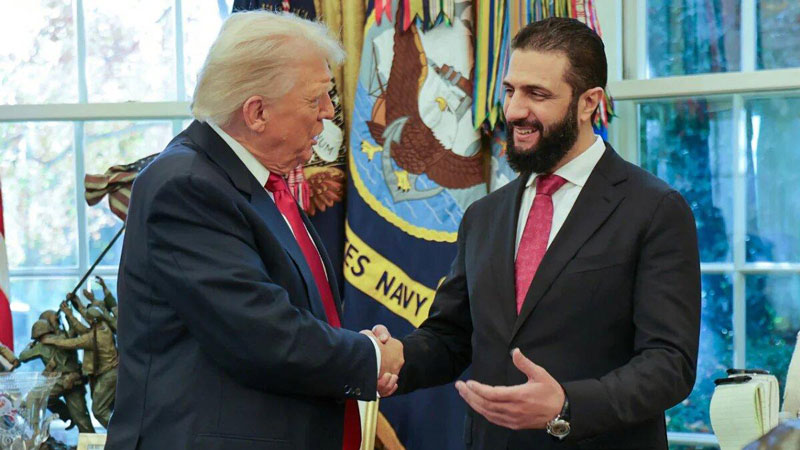
To this end, the U.S. strategy in Syria has moved toward a recalibrated approach that prioritizes stabilization, counterterrorism, and gradual reintegration over ambitious state-building or regime isolation. Washington is engaging pragmatically with authorities in Damascus to contain violence, prevent renewed escalation, and shrink the space available to armed non-state actors, while reinforcing the principle that the monopoly over the use of force must ultimately rest with the Syrian state. This approach combines sustained diplomatic engagement, security coordination, and mediation—particularly between Damascus and the Syrian Democratic Forces (SDF)—with a clear expectation that the SDF be progressively integrated into national military structures under an internationally monitored timeline. It also reflects a significant policy shift following President Trump’s pledge to give Syria a “new chance,” culminating in congressional action to repeal the Caesar Syria Civilian Protection Act and lift broad U.S. sanctions. This enables reconstruction assistance, economic engagement, and institutional recovery while maintaining targeted measures against individuals responsible for war crimes and corruption, although the reconstruction assistance is currently insufficient, and adding Syria to the travel ban would undermine the effectiveness of this policy by both constraining economic reintegration and blocking Syrian businesspeople from entering the United States to engage with American counterparts.
In Lebanon, a recalibrated U.S. strategy would similarly emphasize stabilization over transformation, focusing on restoring state authority, insulating national institutions from external manipulation, and preventing renewed conflict. This would entail sustained political and economic engagement with Beirut to support governance and financial reforms, close coordination with international financial institutions, and expanded assistance to the Lebanese Armed Forces (LAF) as the sole legitimate national defense institution. Central to this approach would be a clear, internationally backed framework for strengthening state sovereignty, including gradual steps toward disarming Hezbollah and consolidating all weapons under state authority, paired with diplomatic efforts to restrain Israeli unilateral escalation and limit Iranian political and security interference. Through calibrated pressure, conditional support, and active mediation, the United States could help Lebanon stabilize its fragile political order while reducing the risks of regional spillover and preserving its own strategic interests.
Further, Washington must prioritize restraining Israeli cross-border escalation, which has repeatedly undermined the already fragile security environment in both Syria and Lebanon and risks triggering broader conflict. In southern Syria, Israel has not only conducted frequent airstrikes but also expanded its ground presence and checkpoint operations in Quneitra province, setting up military posts inside Syrian sovereign territory and intensifying incursions that Syrian officials say violate the 1974 disengagement agreement and heighten tensions along the Golan Heights border. Alongside incursions, a deadly Israeli raid in Beit Jin in December 2025 killed at least 13 civilians, illustrating how kinetic operations aimed at militant targets have inflicted significant civilian harm and increased local hostility.
In Lebanon, the pattern of intense Israeli operations against Hezbollah has continued through late 2025, with multiple airstrikes, artillery, drone operations, and ground activities reported across south Lebanon—including north of the Litani River—reflecting an escalation that goes beyond isolated engagements and contributes to persistent insecurity. In November 2025, an Israeli airstrike on the Ain al-Hilweh Palestinian refugee camp near Sidon in southern Lebanon killed at least 13 people, including children, marking one of the most severe violations of the tenuous ceasefire and drawing international criticism over civilian harm and escalation risks. In December 2025, conflict monitoring data indicate that Israeli military activity across southern and eastern Lebanon has intensified, with independent sources recording an average of six Israeli strikes per day—or about one every four hours—despite an official ceasefire, resulting in frequent violations and civilian casualties that undermine reconstruction and peace prospects.
In this context, the United States must use its diplomatic leverage to urge restraint from Israel and reinforce commitments to ceasefire agreements, ensuring military actions are limited to defensive necessity and accompanied by robust communication channels that reduce the risk of unintended escalation. Through such focused engagement with Israeli leadership, including conditioning security cooperation on de-escalatory behavior, Washington can help stabilize evolving landscapes in Syria and Lebanon and safeguard broader regional security.
In parallel, Washington should expand its support for institutional rebuilding by providing targeted financial assistance and technical advisory support aimed at restoring core state functions, improving governance capacity, and reinforcing economic and administrative resilience. Equally important, the United States should prioritize strengthening its ties with the national armed forces in each country, supporting their professionalization, cohesion, and accountability. By bolstering the capacity and legitimacy of state militaries as unified national institutions, the United States can help reinforce the principle of state sovereignty, reduce reliance on militias, and contribute to longer-term stability.
Taken together, these dynamics underscore that the current Levant moment presents both significant risks and rare opportunities for U.S. policy in Syria and Lebanon. Success will depend on a calibrated strategy that balances restraint with engagement, prioritizes stabilization over maximalist objectives, and reinforces the centrality of sovereign state institutions over armed non-state actors. By coordinating closely with Arab partners, managing relations with Israel to prevent destabilizing escalation, and sustaining pragmatic diplomatic engagement with Damascus and Beirut, the United States can help shape a more stable Levantine order. While the path forward will inevitably be incremental and contested, a consistent focus on institution-building, mediation, and the restoration of state authority offers the most credible route toward reducing conflict, curbing external interference, and advancing a more durable regional equilibrium. One year after the collapse of the Assad regime and nearly a year following the formation of new governments in Syria and Lebanon, this juncture offers a pivotal Levantine moment for the United States to recalibrate its Middle East strategy, employing targeted engagement to shape regional dynamics, strengthen American influence, and highlight the strategic effectiveness of a measured, state-centered approach in promoting enduring stability.